
Ontario Directory Collections by Era
The strongest public bibliography gives Ontario a long but uneven directory trail. It includes stand-alone Ontario titles and regional books with an Ontario section. The table distinguishes verified publication references from the library's broader holdings. “Exact run not published” is an access fact, not a reason to invent missing years.
| Collection or edition | Year | Publisher or compiler | Where and value |
|---|---|---|---|
| San Bernardino County Directory, Ontario section | 1898 | Arthur M. Bushnell, Kingsley-Barnes & Neuner | History Room bibliography; county and local names |
| Ontario City Directory | 1901 | W. A. Norton, Ontario Observer | History Room shelf; name, address, occupation clues |
| Ontario Colony Directory | 1903 | Dewey and T. E. Archer, Ontario Record Print | History Room bibliography and local research lead |
| Directory of Pomona, Ontario section | 1907 | Pomona Business Men's Association, Daily Progress | Regional coverage; compare address and business entries |
| Pomona resident and business directory, Ontario section | 1909-10 | Edward F. Parker, Pomona Times | Regional shelf or catalog check required |
| Regional directory, Ontario section | 1911 | Los Angeles City Directory Co., R. C. Deveruex | Regional name and address lead |
| Pomona directories with Ontario sections | 1928, 1931 | Edition-specific publisher records | Verify the physical volume and section |
The early bibliography comes from a city-commissioned historical report and is a verified starting spine, not a complete physical inventory. The early titles are summarized in the Ontario historical report and bibliography. For a current shelf list, ask the History Room for the title, publisher, year, and call-number details before planning a long visit.
Ontario's City Directory Shelf Needs a Check
The Robert E. Ellingwood Model Colony History Room at the Ovitt Family Community Library is the primary Ontario repository for historical directory work. The collection page names city directories, the Master Biography File, local newspapers and an online index, building surveys, maps and aerials, photographs, and high-school yearbooks for Chaffey, Ontario, and Colony. Staff also help with old businesses, classmates, ancestors, and historic houses.
The History Room is at 215 E. C Street, Ontario, California. Posted hours are Monday through Wednesday from 1 to 6, Thursday from 1 to 9, and Friday from 1 to 6; it is closed on weekends. The listed phone is 909-395-2206, and LocalHistory@OntarioCA.gov is the research contact. Off-site manuscript material requires at least one day's notice, collection and box numbers, and retrieval is limited to four boxes at a time.
The Ontario City Library access page shows the public library route. The more specific History Room page should be checked for current hours and staff guidance before relying on an older directory lead.
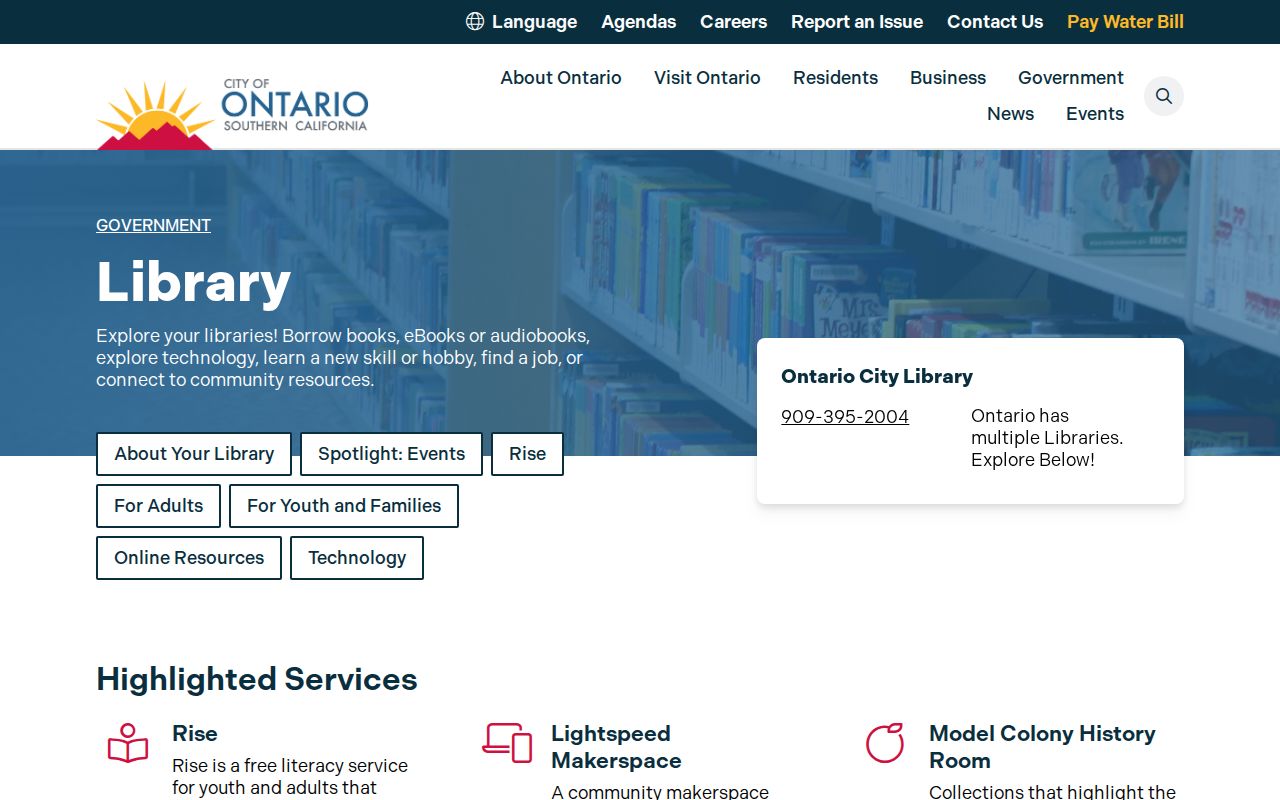
The library image belongs beside the coverage table because the room, rather than a statewide search box, is where many local editions must be verified.
Reading an Ontario Directory Line
Read the front matter before interpreting an Ontario city directory. Publishers change abbreviations, homeowner marks, telephone codes, and the order of street sections. A typical alphabetical entry can contain a surname, given name or initial, spouse notation, occupation, employer, residence, and a separate business address. A reverse section changes the search direction from name to street and number.
| Entry field | What it can mean |
|---|---|
| Name | Indexed person, spouse, widow notation, or business name |
| Occupation or employer | Work clue that may connect the entry to a local institution |
| Residence | House number and street for that publication year |
| Business address | Commercial location that may differ from residence |
| Vacancy or unit mark | Publisher's statement about a numbered unit in a criss-cross section |
- Criss-cross directory
- A reverse street section that lists an occupant or business by numbered location.
- Householder index
- An index organized around a household head or primary name, where the volume provides one.
- Abbreviation key
- The publisher's front-of-volume guide that defines marks such as h, r, bds, or wid.
- Index versus evidence
- A directory entry is a dated lead; a deed, certificate, or court file may be needed to verify a fact.
In the 1957 Luskey Brothers & Co. Ontario and Upland criss-cross sample, the street guide begins with a street and direction, notes intersections and building numbers, and separates apartments into units. It also lists businesses by type and can mark a unit vacant. Use that structure without quoting a private resident from an unverified excerpt.
Ontario Reverse Pages: Street to Occupant
The reverse half of an Ontario directory is useful when a family-history question begins with a house or business rather than a surname. Locate the street in the guide, confirm the direction and cross streets, read the numbered sequence, and capture the unit or business notation. Then move to the alphabetical pages to test the name, occupation, spouse, or business connection. The two halves should agree on the edition before a move is inferred.
A street entry does not establish title. It may reflect an occupant, a business, a boarding arrangement, a vacancy, or a publisher's omission. Compare the number with the 1907 Sanborn atlas, a deed legal description, a building survey, or a newspaper notice. If the street has changed form, record both spellings and search the surrounding numbers.
This reverse-search method belongs to the historical shelf. Modern parcel and deed work follows a different chain through the Ontario by-street records.
Follow an Ontario City Directory Household
A single directory year is a snapshot. Consecutive editions reveal movement, an occupation change, a spouse notation, or a disappearance that needs another source. Use a working table with one row per edition and separate columns for name, address, occupation, household notes, and source page.
- Start with the most certain name and address, then find the first edition that contains both.
- Search forward and backward through nearby editions, keeping spelling, initials, spouse names, and occupation changes.
- Flip to the criss-cross section to test the street number and identify a business or adjacent entry.
- Pair the directory year with a nearby census, deed, permit, newspaper, or yearbook rather than filling an absent year by guesswork.
- Use an obituary, probate file, or later directory to explain a final appearance, move, or changed household.
Disappearance is ambiguous. A family may have moved, a person may have died, the edition may omit the address, or the publisher may have changed its name rules. A gap is a prompt for comparison, not a conclusion.
Pair Ontario Directories with the Census
Federal census schedules are a strong companion to the Ontario volumes because the public series reaches through 1950 under the 72-year rule. Census entries can add household composition, age, birthplace, occupation, and an enumeration-district or address clue. Directory editions fill the years between decennial schedules and may show a business, spouse notation, or street move that a census misses.
Do not force census geography to match a modern ZIP code. Enumeration districts and historic boundaries differ. Confirm the street and number through the directory guide, Sanborn sheet, tract map, or newspaper. A 1907 map can show the building context, while a later directory can show the named occupant.
The 1907 Sanborn atlas has 17 Ontario sheets and is available through the Library of Congress collection. It shows footprints, materials, uses, and street numbers, not a complete list of residents.
Ontario's Model Colony Record Trail
Ontario's 1882 Model Colony and its Euclid Avenue grid explain why local history research reaches beyond a printed directory. San Bernardino County existed before the city's 1891 incorporation, while early settlement records connect land, irrigation, agriculture, nurseries, dairies, and company activity to people who may not appear in a modern household source. The directory shelf is one layer in that older record landscape.
Historic-context work for Ontario Ranch used PIMS, census records, directories, voter material, newspapers, Bureau of Land Management land records, and oral contacts with long-time dairy families. That combination is a useful local model: use a directory to name a place, then use land, map, newspaper, or family material to explain the place.
Ontario Resident Biography Files and Newspapers
The Master Biography File can resolve a long-term Ontario name when the directory is thin or a surname has several variants. The newspaper index can date arrivals, departures, weddings, deaths, club activity, business openings, and property events. Chaffey, Ontario, and Colony yearbooks add class, activity, portrait, and faculty clues. These sources serve family history and reconnection work, not a promise of current residence.
Use the newspaper or biography hit as a lead. Confirm an exact death, marriage, property transfer, or court event with the proper custodian. A funeral notice can point to an obituary, but a death certificate or probate filing is the stronger endpoint.
Ontario Directory Archives and Treasures
Ontario Treasures is a growing digital collection of photographs, building surveys, and local ephemera. It is valuable for visual context and may expand over time, but it is not a guaranteed complete directory run. County Historical Archives material is cataloged through ArchivEra, where a researcher can search by keyword, creator, subject, or collection and browse the holdings. The catalog is free; originals may require a visit or a request.
Use an asterisk for truncation in ArchivEra and avoid quotation marks when the catalog instructions call for that search style. Search Ontario, Chaffey, Euclid, a family surname, a business, or a collection name separately. A catalog description tells you where a box or series exists, not necessarily that every page is digitized.
Open the San Bernardino County Historical Archives catalog after checking the library shelf. The two repositories cover different material and should be searched in parallel.
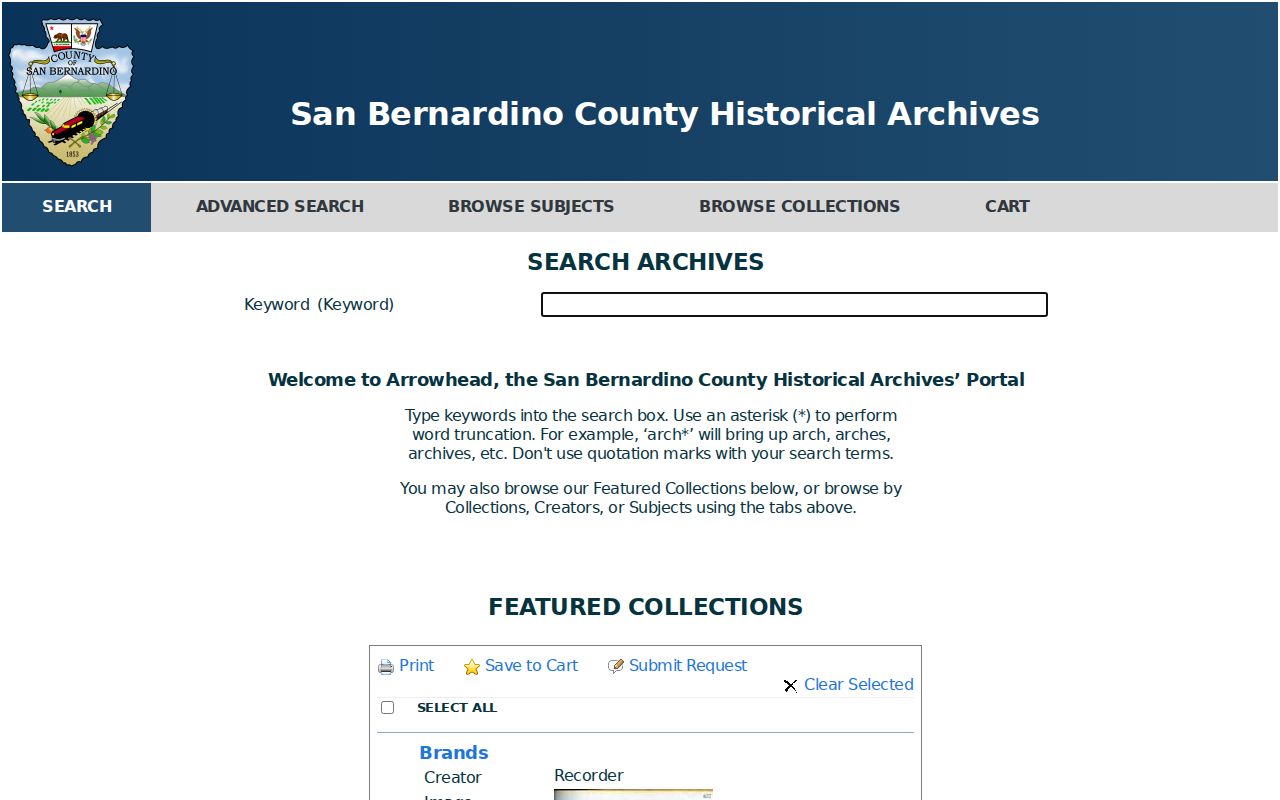
The county archive screen is a catalog doorway, not an online substitute for the physical directory shelf. Preserve collection and box references when requesting material.
Note: The official History Room page confirms city directories but does not publish a complete publisher-and-year inventory, so verify the exact volume before promising coverage.